
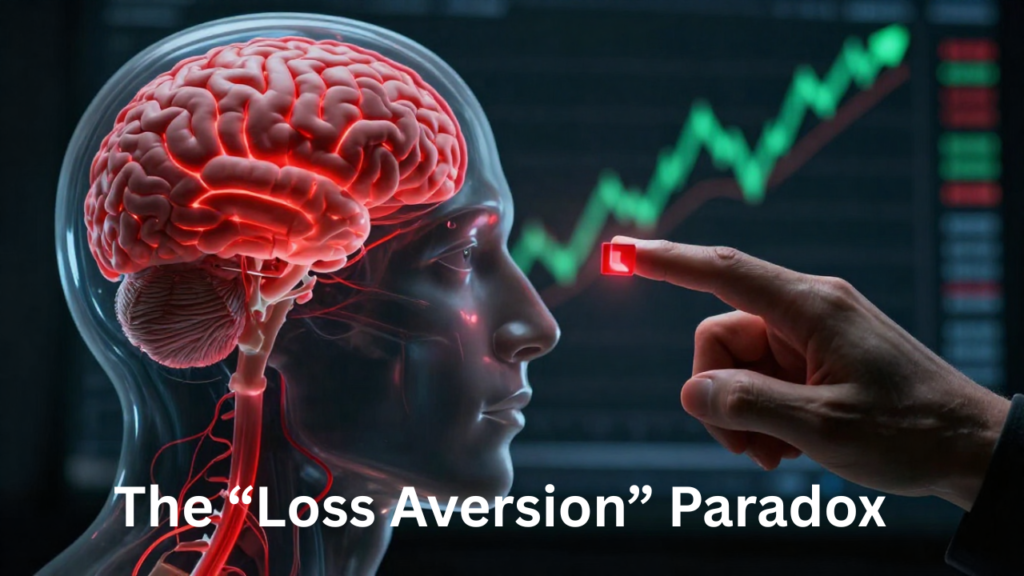
In the high-stakes world of proprietary trading, your greatest adversary is not the market, the algorithms, or the news cycle. Your greatest adversary is the three pounds of gray matter between your ears.
As a trader, you are constantly fighting against an evolutionary blueprint that was designed for survival on the African savanna, not for navigating electronic order books. One of the most destructive manifestations of this biological mismatch is Loss Aversion. If you have ever found yourself holding a losing trade long past your stop-loss, or aggressively closing a winning trade at the first sign of a pullback, you are not failing because you lack “talent.” You are failing because you are a victim of a deep-seated biological trap.
Understanding Loss Aversion is not just an exercise in psychology; it is a clinical necessity for any trader who wants to reach the funded professional level.
🧬 What is Loss Aversion?
Loss Aversion is a cognitive bias identified by psychologists Daniel Kahneman and Amos Tversky as a cornerstone of Prospect Theory. In simple terms, Prospect Theory describes how people make decisions involving risk and uncertainty. It discovered a fundamental asymmetry in the human brain: the pain of losing is psychologically about twice as powerful as the joy of gaining.
If you find a $100 bill on the street, you feel a certain amount of pleasure. However, if you lose $100 from your wallet, the emotional distress you feel is roughly twice as intense as the pleasure you felt from finding that same amount.
In the context of trading, this means that your brain is wired to do everything in its power to avoid the “pain” of a realized loss. This is why you will sit through a 10% drawdown on a losing position, hoping it “comes back,” while simultaneously panic-selling a winning trade after a 2% gain. Your brain is trying to “save” you from the pain of a loss, even when that behavior destroys your equity curve.
📉 The Biological Trap: Why You Hold Losers
When a trade moves against you, your amygdala—the primitive part of your brain responsible for the fight-or-flight response—is triggered. It perceives a loss not as a simple deduction of digital capital, but as a genuine threat to your survival.
When you are in a losing trade, your brain enters a state of “threat detection.” It views the loss as an open wound. If you close that trade, you are forced to “realize” the loss, which your brain interprets as a permanent injury. To avoid this pain, you hold the position, hoping the market will reverse. This is the Disposition Effect: the tendency for investors to sell assets that have increased in value (to lock in the “pleasure” of a win) while holding assets that have decreased in value (to avoid the “pain” of a loss).
By holding the loser, you are not trading the market; you are attempting to manage your internal chemistry. You are ignoring the technical setup—which told you to exit—in favor of a chemical desire to avoid feeling the sting of failure.
📊 The Mathematical Cost of Loss Aversion
To understand why this is a career-ending habit, we must look at Expectancy. Expectancy is the average amount you can expect to win or lose per trade, calculated by your win rate and your average win-to-loss ratio.
If you are loss-averse, your average loss becomes massive because you hold losers too long, and your average win remains small because you take profits too early. This leads to a scenario where you could have a 60% win rate—meaning you are right more often than you are wrong—and still lose money.
For example, if you win 6 trades for $100 each, you have made $600. If you lose 4 trades, but because you were loss-averse, you let them run until they cost you $200 each, you have lost $800. Despite being “right” 60% of the time, you have a net loss of $200. This is the silent killer of prop trading accounts.
🛠️ The “Circuit Breaker” System: Overriding Your Biology
Since you cannot “think” your way out of a biological response while you are in the middle of a trade, you must implement Circuit Breakers. These are pre-set, automated rules that remove the necessity for emotional decision-making.
1. The Hard Stop-Loss (The “Automated Execution”)
If you are manually deciding when to exit a losing trade, you are already losing. You must use hard stop-losses that are entered into the broker platform at the moment of entry. By automating the exit, you take the “pain” of the decision away from your amygdala and place the execution in the hands of the software. Once the stop-loss is set, you are not allowed to move it (widening the stop). Moving a stop-loss is an act of desperation, not analysis.
2. The “Pre-Defined Target”
Just as you must automate your exit for losses, you must automate your exit for wins. The impulse to “take profit early” is just the other side of the loss-aversion coin. By identifying your exit target based on technical analysis (e.g., support and resistance levels) before you enter the trade, you prevent the impulse to “grab” a small win because you are afraid the market will turn around and take it away.
3. The “Observer Effect” Technique
As we have discussed in previous articles, viewing your P&L in dollar signs triggers an intense emotional reaction. When you see a “minus $500” on your screen, your brain screams “danger.” Instead, switch your display to R-Multiples. An “R-multiple” is a measure of risk-adjusted return, where 1R is equal to your initial risk on the trade. When you view a loss as “-1R” instead of “-$500,” you are viewing the trade as a unit of risk, not a threat to your bank account. This helps keep your prefrontal cortex—the logical, analytical part of your brain—in the driver’s seat.
📉 The “Sunk Cost” Fallacy
Loss aversion is frequently exacerbated by the Sunk Cost Fallacy. This is the tendency to continue an endeavor once an investment in money, effort, or time has been made, even if the current evidence suggests that continuing is detrimental.
In trading, you have already spent time analyzing the setup, you have spent time managing the order, and you have committed capital. Your brain tells you that if you close the trade, all that effort was for nothing. You want to “get your money back.”
However, the market does not care how much time you spent on the analysis. The market does not care how much you are down. Every moment you are in a trade, you are making a new decision to be in that trade. If the setup is no longer valid, every second you hold is a fresh mistake, regardless of how much you have already “invested” in that position.
🏁 From Fighter to Scientist
The transition from a struggling trader to a funded professional is the transition from a “fighter” to a “scientist.” A fighter reacts to every threat and tries to “win” every exchange. A scientist acknowledges that the environment is stochastic (random) and that their role is simply to manage the probability of their system’s outcomes.
To eliminate loss-aversion, you must:
- Accept that losses are a cost of business. They are not personal failures; they are data points.
- Automate your exits. Never trust your brain to make a rational choice when it is flooded with cortisol.
- Think in R-Multiples. Remove the dollar-sign threat from your visual field.
You are not trading your opinion on where the market will go; you are trading your system’s edge. If you allow your biology to dictate your exits, you forfeit that edge. Master your loss aversion, and you master the single greatest hurdle between you and consistent profitability.
Disclaimer: This information is for educational and informational purposes only and does not constitute financial, investment, or legal advice. Trading in financial markets involves significant risk of loss and is not suitable for all investors. Any decisions made based on this content are the sole responsibility of the reader.