
The Virtue of Being Late
The market is driven by emotion—greed and fear—and these emotions manifest as exaggerated price moves, known as overreactions. The Level 1 trader is always chasing these moves, succumbing to the Fear of Missing Out (FOMO) and buying at the absolute peak of emotional exhaustion.
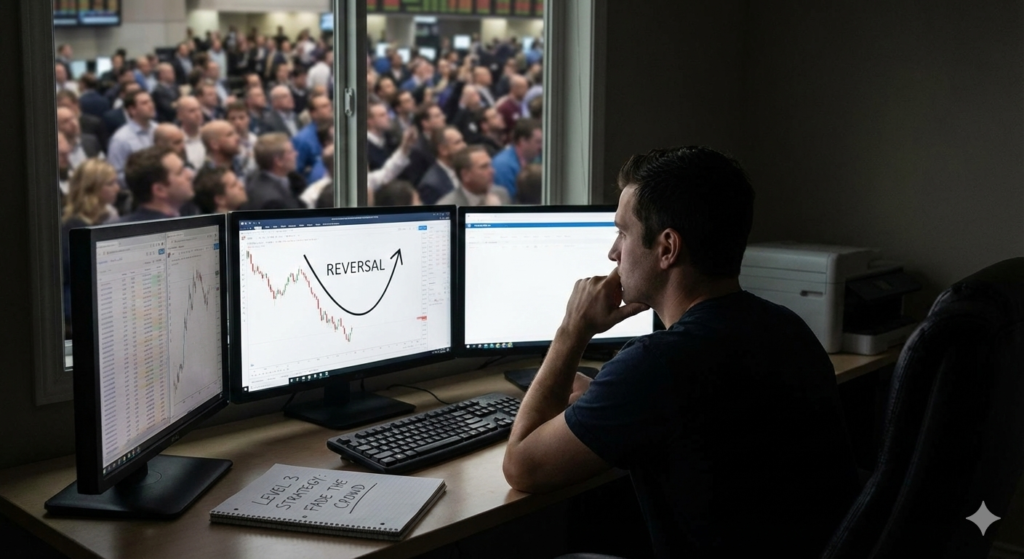
The Level 3 trader, having modeled the Level 1 errors and survived the Level 2 liquidity sweeps, understands the market is self-correcting. Their primary mission is to Fade the Crowd—to strategically enter a trade against a powerful, extended move, anticipating the necessary corrective action.
Fading the crowd is one of the highest R-Multiple strategies available because it involves selling at the price of maximum greed or buying at the price of maximum fear. However, it requires immense discipline and a set of clear rules to differentiate a genuine reversal from simply stepping in front of a freight train.
Phase I: The Anatomy of a Crowded Trade (Level 1 Exhaustion) 🛑
Fading is not guessing the top or bottom; it is waiting for quantifiable evidence that the crowd has exhausted its emotional fuel.
1. The Volume/Price Disconnect (Declining Momentum)
A trade is emotionally exhausted when the price continues to rise aggressively, but the volume starts to drop or flatten.
- The Interpretation: Initially, high volume drives the price up (Level 1 traders are piling in). As the price moves higher, fewer and fewer participants are willing to buy at those elevated levels. The final push is often driven by a few desperate buyers or algorithmically thin volume. The fuel is running out.
2. Extreme Deviation from the Mean (Statistical Overextension)
The market always reverts to the mean (the average price). A trade is over-extended when the price deviates far beyond its normal range of volatility.
- Quantifying the Extreme: Use indicators that measure distance from a moving average. A close that pushes outside the 2-standard-deviation Bollinger Band is often a strong signal that the Level 1 move has run out of mathematical room and is due for a reversal or a period of sharp consolidation. This statistical overextension acts as a gravitational pull for the price.
3. The Sentiment Extreme (The Crowd is All In)
When market sentiment tools (like the Commitment of Traders report in FX, or options skew in equities) signal an extreme reading (e.g., 90% of retail accounts are net long), it signals that there are very few new buyers left to enter the market. The trade is now crowded, and any small shock can trigger a violent unwind.
Phase II: The Backward Induction Protocol for Fades 🛠️
Fading a strong move is inherently risky. Therefore, it must be defined by the Game Theory rule of Backward Induction—defining the exit and risk before the entry.
1. Define the R-Multiple Goal
A fade trade should only be executed if it offers an extremely high R-Multiple (e.g., 3:1 or 4:1) because the initial risk of reversal is high.
- The Target: Your target (the reward) is the market’s reversion back to its average (the mean). This is often a clearly defined zone, like the 20-period Simple Moving Average (SMA) or the center line of the Bollinger Band.
- The Stop: Your stop (the risk) must be placed just beyond the definitive peak of the exhausted move, often protected by the tip of the wick left by the final spike.
2. The Execution: Trading the Correction, Not the Peak
Never try to short the exact high or buy the exact low. Wait for the market to give you a clear signal that the initial momentum has failed.
- The Failure Signal (The Confirmation): After a strong spike, wait for the first candlestick to close against the trend (e.g., a massive green candle is followed by a clear red candle, forming a reversal pattern like an engulfing candle or a pin bar). This signal confirms that selling pressure has re-entered the market and overwhelmed the last buyers.
- Entry Point (The Re-Test): Enter the fade trade on the next minor pullback toward the high/low of that reversal candle. This low-risk entry, often called the “re-test”, provides a tighter, more logical stop area and maximizes the R-Multiple.
Phase III: The Psychological and Time-Frame Filters 🛡️
Successful fading requires more than just technical signals; it requires psychological fortitude and a smart time-frame strategy.
1. The Time-Frame Lag Filter
The shorter the time frame, the more emotional the price action. Fading must be executed on a clean, higher time frame to confirm the exhaustion is genuine.
- Rule: If you see a potential fade setup on the 5-minute chart, you must confirm that the 15-minute or 30-minute chart is showing equivalent statistical overextension. The longer time frames filter out the noise and limit the number of trades taken against the trend, ensuring you are only fading major emotional spikes, not minor volatility.
2. The Discipline of Discomfort
Fading the crowd is not an analytical challenge; it is a psychological challenge. The market is screaming for you to join the move, but discipline demands you take the opposite, uncomfortable position.
- Fader’s Mindset: Recognize that a fast-moving, extended market is not a sign of opportunity, but a sign of risk. The true opportunity is the inevitable correction that follows the emotional high. If you feel an intense urge to join a spike, that is your strongest signal to look for a fade setup.
3. Managing the Cost of Being Early
Many traders are stopped out because they try to enter the fade trade too early. The fear of missing the peak causes them to enter before the reversal candle confirms the failure.
- The Cost: Accept that you will be early sometimes. The core of your strategy must be to manage the small losses from being early (by using tight, confirmed stops) while maximizing the large profits from being right. Never increase your position size when fading a move; maintain discipline.
The Discipline of the Counter-Trade ✨
Trading the reversal is the ultimate expression of Level 3 strategy. It is the methodical, unemotional process of profiting from the predictable self-correction of an emotional market.
The Level 1 trader enters on FOMO; they buy the peak and panic-sell the correction. The Level 3 trader patiently waits for the quantifiable exhaustion of that emotional capital, then uses Backward Induction to define a high R-Multiple entry after the reversal is confirmed.
By applying the principles of volume exhaustion, extreme mean deviation, and the iron-clad rules of confirmation, you stop chasing the unsustainable highs and lows of the crowd. You patiently wait for the Level 1 traders to exhaust their emotional capital, allowing you to enter the market at the moment of maximum strategic advantage, turning the crowd’s predictable error into your consistent profit.
Disclaimer: This content is provided for educational and informational purposes only. It does not constitute, and should not be relied upon as, personalized investment advice, a recommendation to buy or sell any security, or an offer to participate in any trading activity. Trading involves substantial risk, and past performance is not indicative of future results.