
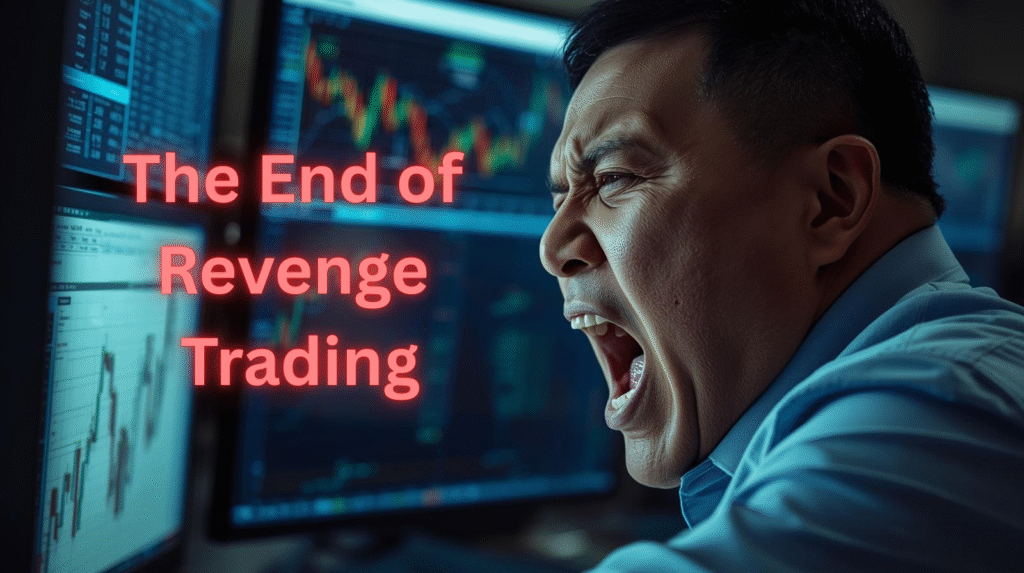
Introduction: The Most Expensive Impulse 💸
You’ve just taken a painful, unexpected loss. The market was “supposed to” go your way, but it didn’t. In the pit of your stomach, a destructive impulse ignites: the need to get the money back—and fast. This is revenge trading, and it is the single most efficient way to turn a manageable loss into a career-ending drawdown.
Revenge trading is defined as the impulsive act of increasing position size, shifting strategy, or violating pre-defined risk rules immediately following a loss, driven by the emotional need to quickly recoup the deficit. It is fundamentally a psychological challenge rooted in human biology, specifically the brain’s reaction to financial loss. For a professional prop trader, this cannot be managed with “willpower”; it must be eliminated with a scientific approach using procedural safeguards that bypass the emotional centers of the brain. This deep dive will dissect the neurological basis of this impulse and provide a rigorous, actionable framework for achieving the end of revenge trading.
Phase I: The Neuroscience of Financial Pain (The Dopamine Loop) 🧠
To eliminate a behavior, we must first understand its biological driver. Revenge trading is an attempt to immediately replace a negative stimulus (loss) with a positive one (winning), triggering a powerful, self-destructive dopamine loop.
1. The Loss Aversion Spike and the Feeling of Violation
The financial pain of a loss is processed in the same brain regions that handle physical pain. Specifically, the loss triggers activity in the amygdala (the brain’s fear center) and the ventral striatum, causing a powerful sensation known as Loss Aversion.
Critically, when a trader feels the loss was unfair—perhaps due to a sudden, unpredictable market move or technical failure—it triggers a powerful feeling of injustice or violation, akin to having money stolen from them. This feeling intensifies the anger and the imperative to seek immediate retribution against the market, accelerating the jump into revenge trading. The most common finding in Behavioral Finance, pioneered by Nobel Laureate Daniel Kahneman’s work on Loss Aversion, is that the psychological pain of losing money is roughly two to two-and-a-half times as potent as the pleasure of an equivalent gain.
2. The Dopamine Counter-Attack
To counteract this pain and the feeling of violation, the brain seeks an immediate reward. Trading, with its instant feedback and high variability, is the most accessible “hit.” The impulse to enter a huge, fast trade is an attempt to override the pain signal by immediately flooding the system with dopamine (the brain’s primary reward chemical). This creates the addictive cycle of revenge trading:
- The Vicious Cycle: Loss 📉 ➡️ Pain/Anger/Violation 😡 ➡️ Impulsive Over-Sizing 📈 ➡️ Hope for Instant Recoup 🙏 ➡️ Dopamine Rush 💥
The problem is that the oversized, emotional trade almost always results in a bigger loss, intensifying the pain and leading to an even more desperate, larger emotional recoup attempt. Breaking this cycle is the central task in eliminating emotional recoup.e almost always results in a bigger loss, intensifying the pain and leading to an even more desperate, larger emotional recoup attempt. Breaking this cycle is the central task in eliminating emotional recoup.
Phase II: The Procedural Safeguards (Automating Discipline) 🛑
Since the impulse to engage in revenge trading happens instantly and bypasses logic, the solution must be procedural and automated. You must impose mandatory friction between the impulse and the execution.
3. The “Two-Strike” Rule and the Mandatory Cooling-Off Period
This is the most effective automated defense against the revenge impulse. It must be a written, non-negotiable rule in your trading plan.
- Two Strikes (Max Daily Loss): Define the total maximum loss (e.g., 2% of capital) you can absorb in a single day.
- The Immediate Halt: Immediately upon hitting the first major loss or the total maximum loss, close your trading platform and physically walk away.
- The 30-Minute Lockout: After any single major loss, you must institute a mandatory 30-minute cooling-off period before placing the next trade. During this time, your platform should be physically locked (e.g., you walk away from the keyboard, use a simple script to lock trading capability). This gives the prefrontal cortex (the logic center) time to re-engage and override the primal panic from the amygdala.
4. The Sizing Protocol and the Friction Rule
Revenge trading always involves over-sizing. Prevent this by making it procedurally difficult.
- Fixed Risk per Trade: Mandate that your risk size (e.g., 1% of capital) is calculated before the trading session starts and cannot be changed during the day. Do not use discretionary sizing.
- The Position Size Friction: If you use platform shortcuts for sizing, disable them temporarily. Force yourself to manually calculate and type in the number of contracts/shares for every trade. The small, conscious effort of manual entry creates a moment of friction that can disrupt the rapid-fire revenge impulse.
Phase III: Cognitive Rehearsal and Re-framing (The Behavioral Fix) 🛠️
Once the immediate impulse is contained by procedure, the psychological work of re-framing the loss must begin to achieve the end of revenge trading.
5. The “Loss is a Signal, Not a Failure” Rehearsal
Before every trading session, engage in a brief, structured visualization exercise:
- Visualization Drill: Spend two minutes visualizing taking a full-size, correct loss (a loss that hits your stop as planned). Mentally rehearse your ideal reaction: “The stop was hit. This trade validated my stop placement. I am calm. I will now record the data and wait for the next setup.”
- Reframing the Loss: A successful loss is one that adheres to the plan and hits the stop exactly where it was supposed to. A failed loss is one where you moved the stop or over-sized. The loss itself is data (a price signal), not a judgment of your worth.
6. The “Risk Units” Focus (De-Monetizing the Loss)
The emotional charge of a loss is tied to the dollar amount. To strip the emotion, professional traders use Risk Units (R-Units).
- The R-Unit Protocol: When recording a loss, immediately convert the dollar amount into R-Units. If you lose $100 and your R-Unit is $50, you lost 2R. Focus only on the ‘2R’ figure, not the ‘$100’. This objective metric makes the loss less personal and easier to measure against future profit, reinforcing that a 2R loss can be recovered by one subsequent 2R win, not through impulsive, oversized trading.
For those who want to hear the full discussion on how professionals view and manage Revenge Trading, we strongly recommend viewing this resource:
🎥 Maverick Trading YouTube: Trading Psychology Corner – Revenge Trading
Phase IV: External Accountability and Post-Review 📊
The long-term elimination of revenge trading requires external accountability and a rigorous, targeted review process.
7. The Accountability Check and the Blacklist
If you are struggling with the revenge impulse, your trade journaling must include a specific, mandatory section focused on impulse control.
- The Impulsivity Flag: For every trade, you must answer two questions: 1) Did I deviate from the plan? 2) Was this trade a direct response to a previous loss? If you answer “Yes” to question 2, the trade is flagged as a Revenge Trade and goes onto a Blacklist.
- External Review: If you log three or more Revenge Trades in a single week, you must send your flagged trades and the associated P&L to a trusted mentor or accountability partner. The public accountability serves as a powerful deterrent against future emotional actions.
8. The Positive Feedback Loop (Rewarding Discipline)
While we punish the impulse, we must reward the correct behavior. The end of revenge trading is achieved by replacing the bad habit with a good one.
- Reward Compliance: After a day where you took a full loss (e.g., 1.5% max) but flawlessly adhered to all your rules, reward yourself (a quality dinner, a fun activity). You are rewarding the discipline of taking the loss correctly, not the outcome of the trade. This slowly retrains the dopamine loop to associate discipline and compliance with reward, rather than associating the chaotic pursuit of instant recoup with reward.
Control the Impulse, Control the Career ✨
Revenge trading is a primal financial instinct that must be scientifically and systematically eliminated from your process. It is the failure of the professional mind to control the animal brain.
By implementing strict procedural safeguards like the two-strike rule and mandatory lockouts, and by utilizing trading psychology tools to re-frame the loss as data (R-Units) rather than a painful failure, you dismantle the destructive dopamine loop. The end of revenge trading is not achieved through willpower, but through creating a disciplined system that makes emotional recoup attempts structurally impossible. Master this impulse, and you master the single greatest threat to your long-term success.