
The Observer Effect in Trading: Why Your P&L Is Your Biggest Enemy 👁️
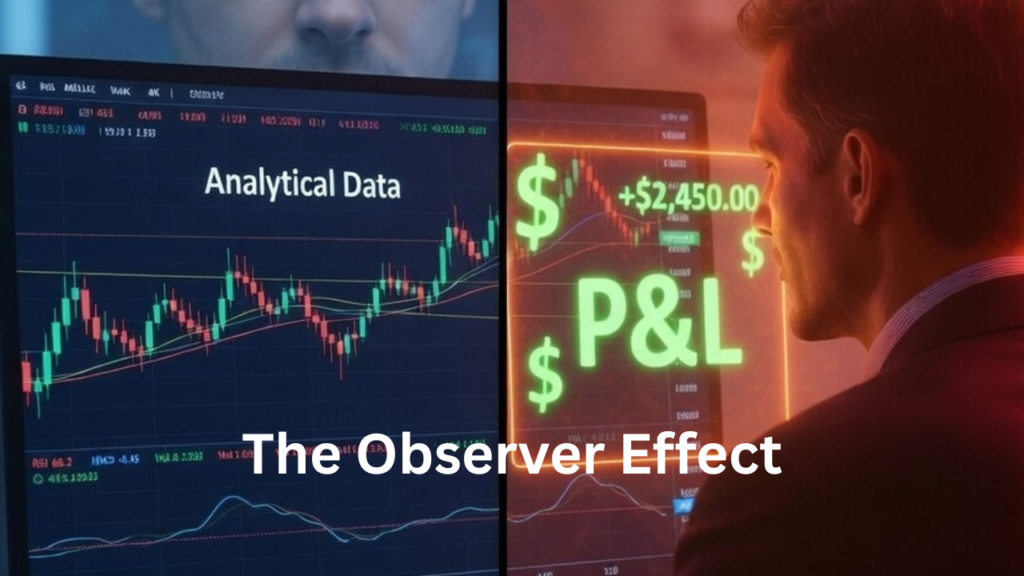
The Invisible Distortion In physics, there is a concept called the Observer Effect, which states that the mere act of observing a phenomenon inevitably changes that phenomenon. If you try to measure the pressure in a tire, you let a little bit of air out, thereby changing the pressure. In the world of prop trading, the same rule applies. The moment you start staring at your “Floating P&L” (Profit and Loss), you change the way you see the market. You stop looking at the price action, the candles, and the trends, and you start looking at what those numbers mean for your bank account. Suddenly, you aren’t trading a chart anymore—you are trading your own emotions. If you want to move from a struggling retail trader to a professional with a funded account, you have to master the “Observer Effect.” You have to learn how to watch the market without letting the dollar signs distort your vision. Phase I: The Psychology of the Dollar Sign Why is looking at your P&L so dangerous? It comes down to how the human brain is wired. We are evolved to react to threats and rewards. When you see a green number showing a +$500 profit, your brain releases dopamine. You feel smart, powerful, and invincible. This often leads to “Greed,” causing you to hold a trade far past your exit target because you want to see that $500 turn into $1,000. Conversely, when you see a red number showing -$300, your brain perceives a threat. It triggers the “Fight or Flight” response. In both cases, the dollar sign forced you to abandon your plan. You stopped being a disciplined trader and started being a biological machine reacting to stimuli. Phase II: Percentage vs. Dollars – Changing the Language One of the first things professional prop firms in Vancouver teach their traders is to stop thinking in dollars. Dollars represent “utility”—they represent rent, groceries, or a new car. When you think in dollars, the stakes feel personal. Professional traders think in Percentages or R-Multiples (Risk units). By switching your display from “Currency” to “Points” or “Percentages,” you create a layer of emotional insulation. It’s much easier to stay calm when you are down 0.5% than when you are down $500, even if the math is exactly the same. Phase III: The Trap of “P&L Watching” We’ve all done it. You enter a trade, and instead of walking away or looking for the next setup, you sit there staring at the flashing numbers. Up $10… down $5… up $20. This constant observation creates a phenomenon called Cognitive Overload. Every time that number flashes, your brain has to process a new emotional micro-adjustment. By the time the price actually reaches a critical decision point, you are mentally exhausted. This is when “Decision Fatigue” sets in, and you make the classic mistake of closing a winner too early or letting a loser run too long. The market doesn’t care about your P&L. The chart doesn’t know where you entered or how much money you have in your account. When you watch the P&L, you are focusing on a variable that has zero impact on where the price goes next. Phase IV: Process-Based Trading – The “Hidden” Strategy If your P&L is your biggest enemy, the solution is simple: Hide it. Many professional-grade trading platforms allow you to hide the floating profit and loss display. This is one of the most underrated “hacks” in prop trading. When you can’t see the money, you are forced to look at the Process. Process-Based Trading looks like this: When you hide the P&L, you treat the trade like a scientific experiment. You are testing a hypothesis. If the hypothesis is wrong, you hit the stop-loss. If it’s right, you hit the target. There is no “stress” because there is no “money”—there is only the execution of the plan. Phase V: The “Funded Account” Mentality The biggest hurdle to passing a prop firm evaluation isn’t the technical strategy—it’s the mental pressure of the drawdown limits. When you know that being down $2,000 means you lose your account, you tend to stare at that -$1,800 mark with pure terror. This is exactly what the “Observer Effect” wants. It wants you to focus on the edge of the cliff so that you eventually fall off. Traders who successfully manage millions of dollars in capital do so by detaching from the result. They focus on the Quality of Execution. They know that if they execute 100 high-quality trades, the math will work out in their favor. They don’t sweat the individual -$500 loss because they aren’t looking at the -$500; they are looking at the fact that they followed their risk management rules perfectly. Phase VI: Practical Steps to Beat the Observer Effect How do you implement this today? It’s about building a “Physical Barrier” between your emotions and your screen. Master the Watcher, Master the Trade The market is a mirror. If you come to it with fear, it will show you things to be afraid of. If you come to it with greed, it will show you “missed opportunities.” The only way to see the market clearly is to remove the “Filter of Self.” When you stop observing your P&L, you start observing the truth of the price action. You move from being a victim of the Observer Effect to being a master of the Metagame. In Vancouver’s prop trading community, we don’t celebrate the “Big Win.” We celebrate the “Boring Trade”—the one where the trader followed the plan, managed the risk, and didn’t let their emotions change the outcome. Once you can watch your account go up and down without feeling a thing, you are ready to be funded. Disclaimer: This information is for educational and informational purposes only and does not constitute financial, investment, or legal advice. Trading in financial markets involves significant risk of loss and is not suitable for all investors. Any decisions made based on this content