
The Seven Deadly Sins of Trading: A Whimsical Warning for Aspiring Masters 😈
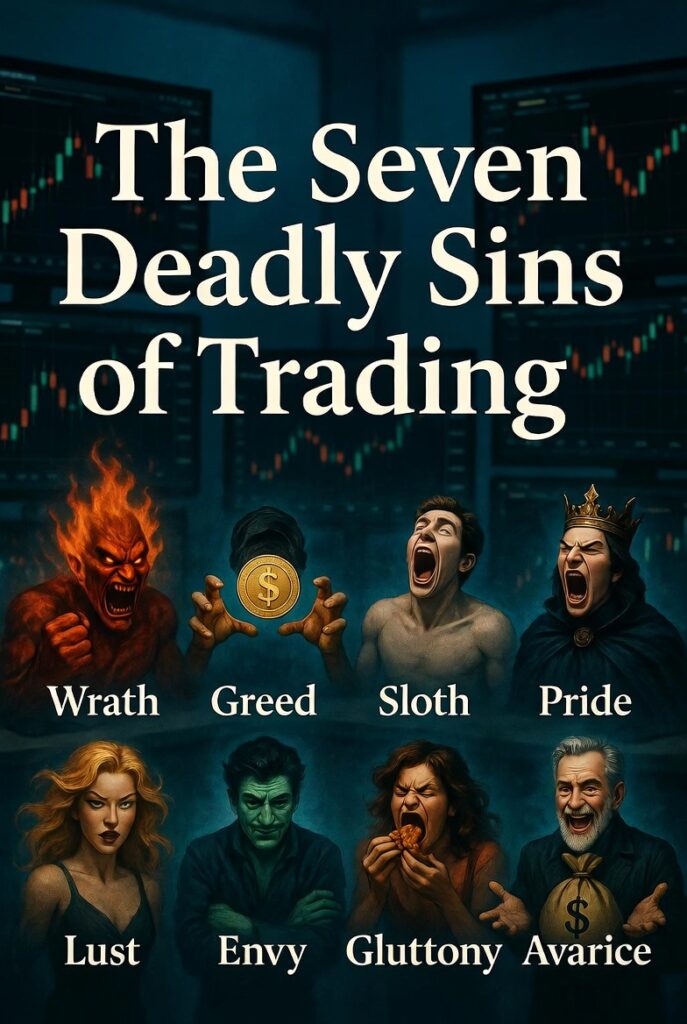
Ah, the world of trading! A realm of charts, data, and exhilarating opportunity. But beware, brave aspiring traders, for lurking beneath the surface of every market are timeless temptations, ancient vices that can lead even the most promising talents astray. We speak, of course, of The Seven Deadly Sins of Trading! These aren’t just quaint moral lessons; they’re potent psychological pitfalls that can derail your discipline, decimate your capital, and dim your bright future in a prop trading firm. Let’s cast a whimsical light on these insidious foes and discover the virtues that offer redemption. 1. Pride: The Sin of Invincibility 👑 The Vice: This is the trader who, after a string of dazzling wins, begins to believe they are the market’s chosen one. Rules become optional suggestions, risk management is for mere mortals, and humility evaporates. “I am too smart to lose,” whispers Pride, just before the market delivers a resounding slap of reality. How it Manifests: Over-sizing positions, ignoring warning signals, refusing to admit a trade is wrong, becoming stubborn against clear market reversals. This is the trader who knows they’re right, even when their P&L screams otherwise. The Cost: Blow-ups. Rapid capital erosion. A very humbling (and often painful) return to Earth. Redemption: Humility 🙏 A truly great trader understands that the market is always right, and no one is above its lessons. Constant learning, respecting risk, and admitting mistakes are the marks of a wise and enduring professional. 2. Envy: The Green-Eyed Monster of FOMO 💚 The Vice: You see another trader (or even a friend on social media) boasting about their incredible gains on a “hot” stock or crypto. Suddenly, your carefully crafted plan feels dull and inadequate. Envy whispers, “Why aren’t you in that trade? You’re missing out!” How it Manifests: Chasing trades that are already extended, jumping into unfamiliar markets or strategies, abandoning your proven edge to follow someone else’s perceived success. You trade out of fear of missing out (FOMO), not out of a strategic setup. The Cost: Late entries, significant drawdowns when the “hot” trade reverses, lack of focus on your own strengths, and consistent underperformance by chasing tails. Redemption: Focus & Self-Reliance 🧘 Concentrate on your own well-defined trading plan. Your unique edge is yours alone. The market offers infinite opportunities; patiently wait for those that align with your system. 3. Gluttony: The Insatiable Appetite for Action 🍔 The Vice: This trader simply cannot get enough. They crave constant market action, overtrading for the sheer thrill of it, consuming every news headline, every social media post, and every tick. Their screens are a chaotic buffet of data, yet they digest none of it truly. How it Manifests: Overtrading, taking low-probability setups out of boredom, excessive screen time leading to mental fatigue, analysis paralysis from information overload, failing to step away even when their edge isn’t present. The Cost: Increased transaction costs, lower quality trades, mental exhaustion, burnout, and a P&L slowly eroded by constant, unfocused activity. Redemption: Moderation & Mindfulness ⚖️ Quality over quantity. Stick to your defined trading hours. Take regular breaks. Focus on deep analysis and high-probability setups. Sometimes, the best trade is no trade at all. 4. Lust: The Alluring Siren of Instant Wealth 💖 The Vice: This isn’t about general greed, but the intense, obsessive desire for immediate, massive profits. It’s the chase for the “get rich quick” scheme, the longing for the one mythical trade that will solve all financial woes. Lust makes you bypass patience and consistency for shortcuts. How it Manifests: Over-leveraging wildly, taking extremely high-risk, low-probability gambles, ignoring prudent risk management for the allure of a huge overnight score, constantly searching for the “next big thing” rather than mastering one. The Cost: Catastrophic losses, blown accounts, and a perpetual cycle of chasing unrealistic dreams rather than building sustainable wealth. Redemption: Patience & Consistency ✨ Understand that true wealth in trading is built systematically, trade by trade, with compounding returns over time. Focus on consistency and disciplined execution, letting small gains accumulate into significant capital. 5. Wrath: The Fury of Revenge Trading 😡 The Vice: After a losing trade or a series of frustrating setbacks, Wrath ignites. The market feels like a personal enemy, and the trader is consumed by a furious desire to “get back” what was lost. How it Manifests: Throwing out the trading plan, taking larger-than-normal positions, entering trades impulsively and emotionally, chasing volatile moves, doubling down on bad ideas. The goal shifts from systematic profit to emotional retribution. The Cost: Rapidly escalating losses, deep psychological damage, and the creation of a vicious cycle of emotional trading. Redemption: Acceptance & Calmness 🌊 Losses are an inevitable part of trading. Accept them as tuition, review them objectively, and then step away. Practice emotional detachment. Focus on your process, not revenge. The market is indifferent to your anger. 6. Greed: The Clinging Hand of Undue Gains 💰 The Vice: Distinct from Lust (the chase), Greed is about holding onto winners for too long, refusing to take profits at predefined targets, or being unwilling to exit a good trade because you want every last pip or cent. It’s the fear of leaving money on the table. How it Manifests: Moving stop-losses against the trade, ignoring profit targets hoping for “just a little more,” letting winning trades turn into losers because of an inability to let go, excessive hoarding of profits without re-investment. The Cost: Missing out on substantial profits as the market reverses, turning winning trades into breakeven or even losing ones, and ultimately, inconsistency. Redemption: Discipline & Prudent Profit-Taking 🎯 Stick to your profit targets. Learn to scale out. Understand that leaving some money on the table is part of a healthy long-term strategy. Discipline dictates when to get in, and when to get out. 7. Sloth: The Laziness of Neglect 😴 The Vice: This is the subtle, insidious sin of cutting corners. Skipping pre-market analysis, neglecting post-trade reviews, failing to backtest new ideas, ignoring essential risk management checks, or simply
The Zero-Sum Reality: Who is on the Other Side of Your Trade? 🤝
The Invisible Opponent Most retail traders treat the market like a giant vending machine. They put in a “Buy” order and expect a profit to come out. But the market isn’t a machine; it’s a room full of people. Every time you click “Buy,” someone else—somewhere in the world—is clicking “Sell.” For you to be right, they have to be wrong. This is the Zero-Sum Reality. To win the game, you have to understand who is sitting across the table from you. In professional trading, this is known as Counterparty Analysis. In a zero-sum environment, capital is not created; it is merely transferred. When you win $1,000, that $1,000 came out of another person’s (or algorithm’s) pocket. If you don’t know whose pocket it came from, there is a very high probability it’s about to come out of yours. Phase I: The Three Main Players When you look at a candlestick chart, you aren’t just looking at price movement. You are looking at the footprints of three very different types of competitors. Each has a different motivation, a different bankroll, and a different “tell” that reveals their presence on the chart. 1. The Sharks (Hedge Funds & Institutional Desks) The goal of these players—the “Smart Money”—is to move massive amounts of capital without “slipping” the price too much. Unlike a retail trader who can enter a full position with one click, a Hedge Fund manager trying to buy $200 million worth of a currency cannot do it all at once without causing a massive price spike that ruins their entry price. 2. The Machines (High-Frequency Algos & HFT) The goal here is to capture pennies a million times a second. These algorithms react to data releases and order flow imbalances in milliseconds—faster than a human can blink. They don’t care about “value”; they care about liquidity. 3. The Bait (Uninformed Retail) The goal of the retail crowd is usually to get rich quickly. These traders are driven by the “Level 1” logic we discussed previously: they follow social media tips, trade based on “obvious” patterns they saw on YouTube, and are highly susceptible to FOMO (Fear Of Missing Out). Phase II: Stop Looking at Lines, Start Seeing People If you only see “Support and Resistance,” you are playing at Level 1. To move to the Metagame, you must translate the candles into human (or machine) behavior. Professional traders don’t trade “patterns”; they trade Liquidity Sweeps and Order Flow. What the Screen Shows What the Metagame Sees Consolidation/Sideways The Sharks are “Accumulating.” They are keeping price in a tight range to fill their massive “Buy” orders without alerting the Crowd. A “Stop Run” (False Breakout) The Machines and Sharks are forcing the “Bait” to close their positions (hit their stops). Since a Sell-Stop is a Market Sell order, the Sharks use those Sells to fill their own “Buy” orders at a better price. Parabolic Move (Vertical) The Bait is FOMO-buying at the top. The Sharks, who bought at the bottom during accumulation, are now “Distributing” (selling) their shares to the excited retail crowd. Phase III: The Mechanics of Market Manipulation To understand the zero-sum reality, you must understand Liquidity. In the market, liquidity is simply the availability of someone to take the other side of your trade. If you want to buy 1,000 shares, you need someone to sell you 1,000 shares. Institutions have a “Liquidity Problem.” Because they trade in such high volume, they cannot find enough “sellers” when they want to buy. To solve this, they create “Bull Traps” and “Bear Traps.” Phase IV: The Ultimate Counter-Party Question 🗝️ Before you enter any trade, you must pass the Counter-Party Filter. Look at your setup and ask yourself: “Who am I taking this money from, and why are they giving it to me?” If your answer is, “I’m taking it from a Hedge Fund because I’m smarter than their $500k-a-year analyst,” you are probably the one being hunted. You are likely trading a “textbook” setup that the Hedge Fund is currently using as bait. If your answer is, “I see a massive cluster of retail stops that were just hit, and the price is now rejecting that level. I am taking this money from the trapped $k=1$ Crowd who just got liquidated,” you are thinking like a professional. You are not fighting the market; you are simply stepping in to collect the “spoils of war” after the Sharks have finished their hunt. Respect the Player, Not the Pattern The market doesn’t owe you anything. It is a highly competitive arena where the most informed and disciplined participants take capital from the least informed. The charts you see are not random; they are a visual representation of a high-stakes game of “Hide and Seek.” To succeed in prop trading, you must stop being a “Pattern Matcher” and start being a Liquidity Hunter. You must respect the fact that on the other side of every “perfect” trade is a professional who might be using that very perfection to trap you. When you stop asking “Where is price going?” and start asking “Where is the pain?”, you have finally begun to master the Zero-Sum Reality. Disclaimer: This content is provided for educational and informational purposes only. It does not constitute, and should not be relied upon as, personalized investment advice, a recommendation to buy or sell any security, or an offer to participate in any trading activity. Trading involves substantial risk, and past performance is not indicative of future results.