
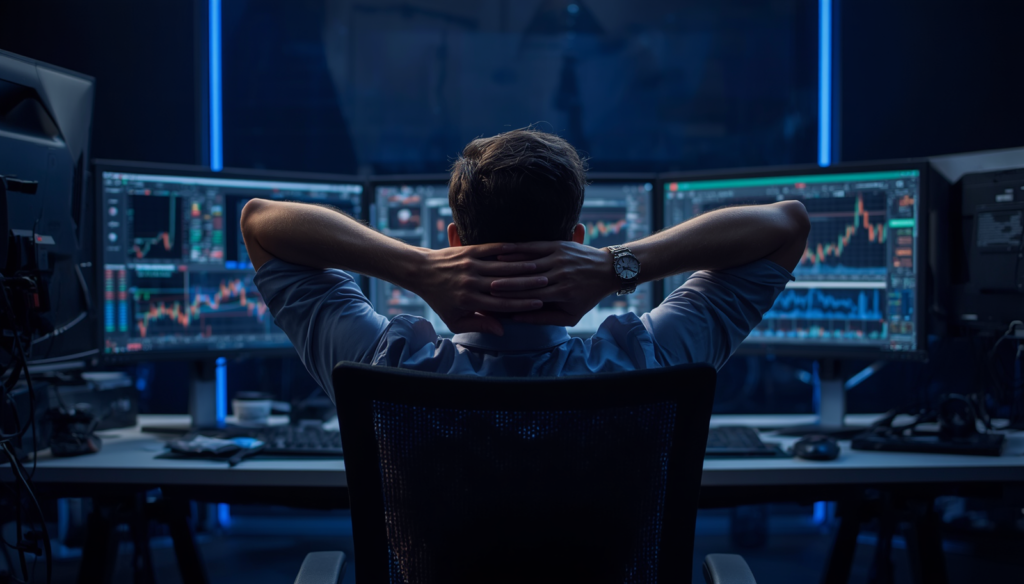
In the world of professional prop trading, we often talk about “mindset” and “discipline” as if they are abstract character traits. We tell ourselves to “just be more disciplined” or “stay calm.” But this is a fundamental category error. Discipline is not a philosophical state of being; it is a biochemical state.
When you are staring at a multi-monitor setup during a high-volatility event, you are not just an analytical mind processing charts. You are a biological organism being flooded with hormones that directly dictate your cognitive capacity. To reach the funded level, you must stop treating discipline as a “choice” and start treating it as a biochemical management project.
🧬 Understanding the “Chemical Hijack”
The primary player in your trading performance is Cortisol, commonly known as the “stress hormone.” Cortisol is produced by the adrenal glands in response to perceived threats. In the wild, this is a life-saving mechanism that prepares you to fight a predator or run to safety.
However, the human brain—specifically the amygdala—cannot distinguish between a literal predator and a “predatory” market move that threatens your Daily Loss Limit.
When the market enters a period of high volatility, or when you are deep in a losing streak, your cortisol levels skyrocket. This triggers a physiological cascade:
- Heart Rate Variability (HRV) decreases: Your heart beats in a rigid, stressed rhythm.
- Tunnel Vision: Your peripheral vision narrows, making it physically harder to see the “big picture” of the market structure.
- Prefrontal Cortex Suppression: Your brain’s command center, responsible for logic, math, and long-term planning, is effectively “offline.”
This is the Chemical Hijack. When your cortisol is elevated, you are literally incapable of executing your trading plan, no matter how much “willpower” you have. You are no longer trading; you are surviving.
📊 The “Afternoon Slump” and Cognitive Load
We have previously discussed the “Rule of 3″—the idea that your brain has a finite budget for high-quality decisions. This is inextricably linked to your Circadian Rhythm and metabolic state.
As the trading day progresses, your glucose levels fluctuate and your brain accumulates “metabolic waste” from constant analytical processing. This is why most “revenge trades” occur in the afternoon. It is not necessarily because the market is testing you; it is because your biological defense system is exhausted.
When your cortisol is high and your cognitive load is maxed out, your brain will automatically default to the most primitive, energy-saving decision-making process: Impulse. This is why you might follow your rules perfectly from 8:00 AM to 11:00 AM, only to blow your account with an impulsive, high-risk trade at 2:00 PM. You aren’t “bad at trading”; you are simply biologically depleted.
🛠️ Tactical Biochemistry: Managing Your Performance
If you want to trade like a professional, you must manage your biology with the same rigor you apply to your risk management.
1. The Cortisol Reset (Physical Circuit Breakers)
You cannot “think” your way out of a cortisol spike. You must use physical interventions to signal to your nervous system that the “threat” has passed.
- The 15-Minute Movement Rule: If you hit a stop-loss, you must physically remove yourself from the environment. A brisk walk or a change of scenery forces the body to metabolize the adrenaline and cortisol.
- Box Breathing: This is a technique used by Navy SEALs to regain control of the autonomic nervous system. Inhale for 4 seconds, hold for 4 seconds, exhale for 4 seconds, hold for 4 seconds. This forces your heart rate to slow and signals to your amygdala that you are not under immediate threat.
2. Nutritional and Metabolic Management
Your brain is the most energy-demanding organ in your body. If you are trading while dehydrated, suffering from blood-sugar crashes (caused by high-carb or high-sugar meals), or sleep-deprived, you are setting your baseline cortisol levels higher before the market even opens.
- Hydration: Even mild dehydration significantly impairs cognitive function and increases stress markers.
- The “Trading Diet”: Professional traders often avoid heavy, high-glycemic meals during market hours. Maintaining stable blood glucose levels prevents the “brain fog” that makes you susceptible to impulsive, emotional trades.
3. HRV Monitoring (The Quantified Trader)
Smartwatches and wearable tech now allow us to measure Heart Rate Variability (HRV). HRV is a measure of the variation in time between each heartbeat—the higher the variation, the more “relaxed” and ready to perform your nervous system is.
- If your HRV is significantly lower than your baseline in the morning, it is a data point. It means your system is already stressed (perhaps from poor sleep or previous-day exhaustion).
- The Professional Decision: On days where your HRV is low, you should decrease your position sizing or skip the session entirely. You are not “skipping work”; you are managing your capital by protecting it from your own biologically-impaired state.
📊 Putting It All Together: The “Biochemical Audit”
If you are a serious prop trader, you should include a “biochemical” column in your trading journal. Next to each trade, log:
- Sleep Quality: (1-5)
- Hydration/Nutrition: (Notes)
- Stress Level: (1-10)
Over time, you will see a undeniable correlation between your “bad” trades and your biological state. You will likely find that 80% of your catastrophic losses happen when your cortisol was high, your sleep was poor, or your cognitive load was maxed out.
🏁 The Scientific Mindset: Owning Your Biology
The “Market” is an external entity, but your “Trading Performance” is an internal process. You cannot control what the market does, but you have absolute sovereignty over the biological environment in which you make your decisions.
When you stop viewing discipline as a moral virtue and start viewing it as a biochemical outcome, everything changes. You stop blaming yourself for “lack of willpower” and start auditing your environment. You stop “fighting” the market and start managing your biology.
The professional is the one who understands that their brain is a tool—and that a tool is only as effective as the environment in which it is operated. Keep your cortisol low, your energy stable, and your prefrontal cortex online. That is the true, scientific edge.
Disclaimer: This information is for educational and informational purposes only and does not constitute financial, investment, or legal advice. Trading in financial markets involves significant risk of loss and is not suitable for all investors. Any decisions made based on this content are the sole responsibility of the reader.