
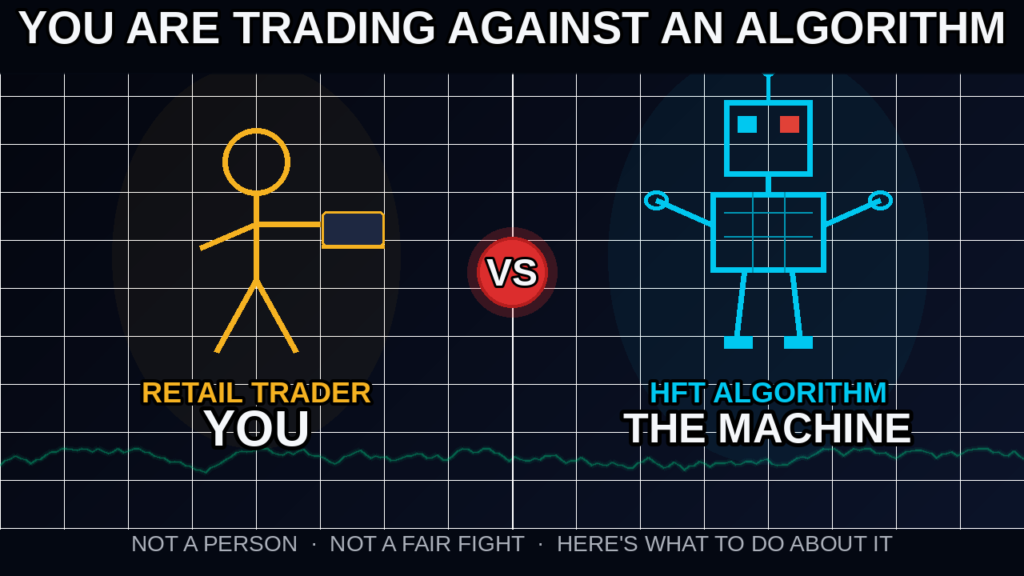
Walk into any trading forum, Discord server, or YouTube comment section, and you will find the same fantasy on repeat: a retail trader sitting at home, staring at a chart, believing they are engaged in a battle of wits against another human being on the other side of the screen.
This is not true. It has not been true for decades. And believing it is one of the fastest ways to blow an account.
In modern financial markets, the counterparty to your trade is rarely a person. It is a machine—a high-frequency trading (HFT) algorithm operating at speeds measured in microseconds, executing strategies designed by teams of PhDs, and deployed by firms with billion-dollar infrastructure budgets.
You are not playing chess against another amateur. You are playing chess against a supercomputer that can see ten thousand moves ahead before you have even registered that the game has started.
To survive in this environment, you must understand what you are actually up against, why the “black box” systems sold to retail traders are a trap, and how to position yourself on the side of the market that does not get eaten alive.
🧠 The Fantasy: Person vs. Person
The retail trader’s mental model of the market looks something like this:
“I think the euro is going up. Someone else thinks the euro is going down. One of us is right, one of us is wrong. May the best analyst win.”
This model is comforting because it implies a fair fight. Two humans, looking at the same data, drawing different conclusions. Skill versus skill. Analysis versus analysis.
The reality is closer to this:
“I just clicked Buy on EUR/USD. My order was intercepted by a server colocated next to the exchange in New Jersey. Before my order reached the matching engine, an algorithm had already analyzed my order flow, compared it against millions of data points, calculated the probability of where I would place my stop-loss, and positioned itself to profit from the liquidity my order created.”
You are not trading against a person with a different opinion. You are trading against a machine that does not have an opinion at all. It has a statistical edge, and it exploits that edge millions of times per day.
⚡ What Is High-Frequency Trading?
High-frequency trading (HFT) is a type of algorithmic trading that uses powerful computers to execute a large number of orders at extremely high speeds. We are not talking about seconds. We are talking about microseconds—millionths of a second.
To put that in perspective:
- The average human blink takes about 100,000 microseconds.
- A high-frequency trading system can analyze market data, make a decision, and execute a trade in under 10 microseconds.
- By the time you have moved your mouse from one side of the screen to the other, an HFT firm has executed thousands of trades.
HFT firms do not care about fundamentals. They do not care about technical analysis. They do not care about support and resistance. They care about speed, order flow, and statistical arbitrage.
Glossary:
- Latency is the delay between when a signal is sent and when it is received. In trading, lower latency means faster execution. HFT firms spend millions to shave microseconds off their latency.
- Colocation is the practice of placing trading servers physically next to an exchange’s matching engine. When you colocate, your orders travel a few feet of fiber optic cable instead of hundreds of miles. This is how HFT firms achieve their speed advantage.
- Order Flow is the stream of buy and sell orders entering the market. HFT algorithms analyze order flow in real time to detect patterns and predict short-term price movements.
- Statistical Arbitrage is a strategy that uses mathematical models to identify and exploit tiny pricing inefficiencies across thousands of instruments simultaneously.
🎯 How HFT Algorithms Exploit Retail Traders
HFT algorithms do not “hunt” retail traders out of malice. They hunt retail traders because retail order flow is predictable, and predictability is profitable. Here are the primary mechanisms:
1. Order Flow Anticipation 🔮
Retail traders place orders in predictable patterns. They place stop-losses at obvious levels. They enter breakouts after the move has already started. They panic-sell at the bottom and FOMO-buy at the top.
HFT algorithms have been trained on billions of data points. They can predict, with statistical reliability, where the retail crowd is likely to place orders. When the algorithm detects a cluster of retail buy orders entering the market, it can front-run that demand—buying milliseconds before the retail orders are filled, then selling back to the retail traders at a slightly higher price.
This is called latency arbitrage, and it is perfectly legal in most markets.
2. Quote Stuffing 📊
Quote stuffing is a practice where an HFT firm floods the market with a massive number of orders that are canceled almost immediately. The purpose is not to trade—it is to slow down competing algorithms by overwhelming their processing capacity.
While the competing systems are bogged down processing the flood of fake orders, the HFT firm gains a speed advantage and can trade ahead of the competition. This practice exists in a regulatory gray area and has been the subject of enforcement actions, but it persists in various forms.
3. Rebate Arbitrage 💰
Many exchanges use a maker-taker fee model. Traders who add liquidity to the order book (makers) receive a small rebate. Traders who remove liquidity (takers) pay a small fee.
HFT algorithms can exploit this structure by placing orders that capture the rebate without taking meaningful market risk. The profits per trade are microscopic—fractions of a cent—but executed millions of times per day, they add up to enormous sums.
4. Spoofing and Layering 🎭
Spoofing is the practice of placing large orders with no intention of executing them, creating the illusion of supply or demand, and then canceling the orders once other traders react to the false signal. Layering is a variation where multiple spoof orders are placed at different price levels to create the appearance of a deep order book.
While spoofing is technically illegal in many jurisdictions, enforcement is difficult, and sophisticated variations of the practice continue to operate in the shadows of the market.
📉 The Black Box Trap: Why Retail Trading Systems Don’t Work
Given that institutional HFT firms dominate the market, a natural question arises: Can retail traders buy their own algorithms and compete?
The answer is no. And the industry that sells “black box” trading systems to retail traders is one of the most predatory corners of the financial world.
What Is a Black Box Trading System?
A black box is a trading system where the logic is hidden from the user. You buy the software, install it, and it generates buy and sell signals—or in some cases, executes trades automatically. The seller tells you the system was “developed by former institutional traders” or “uses advanced AI” or “generated 500% returns in backtesting.”
You are not allowed to see the code. You are not allowed to understand the logic. You are simply supposed to trust the box.
Why Black Box Systems Fail
1. The Latency Gap 🐢
A retail trader’s black box running on a home computer in Vancouver has a latency of 50-100 milliseconds to the exchange. An HFT firm colocated next to the exchange has a latency of under 10 microseconds. That is a speed difference of roughly 5,000 to 10,000 times.
By the time your black box detects a signal and sends an order, the HFT firm has already seen the signal, traded on it, and moved the price. You are not competing. You are arriving after the race is over.
2. The Infrastructure Gap 🏗️
HFT firms invest tens of millions of dollars in infrastructure: colocated servers, custom hardware, microwave transmission towers, and direct fiber optic lines to exchanges. They employ teams of network engineers, quantitative researchers, and software developers with PhDs in mathematics and computer science.
Your black box is running on a consumer-grade computer, connected to the internet through a residential ISP, sending orders through a retail broker that may or may not be routing them to the real market. The gap in infrastructure is not a gap. It is a canyon.
3. The Data Gap 📊
HFT firms consume full order book data—every bid, every ask, every trade, every cancellation—in real time, across every exchange simultaneously. They have historical databases stretching back decades, processed and cleaned by dedicated data engineering teams.
Your black box is consuming a delayed price feed from your broker, with a fraction of the data depth, and has been “backtested” on whatever data the seller decided to include. The data gap alone makes most retail systems obsolete before they are even turned on.
4. The Curve-Fitting Problem 📐
Most black box systems sold to retail traders are curve-fitted—meaning the strategy was optimized to perform perfectly on historical data but has no predictive power for future market conditions.
The seller runs thousands of variations of the strategy against historical data, finds the one that produced the most impressive backtest, and packages it as a “proven system.” What they do not tell you is that the same strategy, tested on out-of-sample data, produces random results at best.
This is not trading. This is data mining. And it is the reason why almost every black box system eventually blows up.
5. The Survivorship Bias in Marketing 🎰
The black box industry is built on survivorship bias. The seller shows you the one strategy that backtested well. They do not show you the 999 variations that failed. They show you the one account that produced a 500% return. They do not show you the thousands of customers who lost everything.
If the system actually worked, the seller would not be selling it for $297. They would be running it themselves and printing money. The fact that they are selling it to you is the only information you need.
🧬 Why Humans Still Lose to Algorithms in Discretionary Trading
Even if you avoid black box systems and trade manually, you are still trading in an environment dominated by algorithms. Here is why that matters:
Speed of Pattern Recognition
A human trader looking at a chart can recognize a head-and-shoulders pattern, a trendline break, or a moving average crossover. An HFT algorithm can recognize thousands of patterns simultaneously across hundreds of instruments, and it can do so in microseconds.
By the time you see the setup, the algorithm has already traded it.
Emotional Consistency
A human trader gets tired. Gets emotional. Gets overconfident after a win. Gets desperate after a loss. Skips trades because they are distracted. Overtrades because they are bored.
An algorithm has none of these problems. It executes the same logic, with the same discipline, on every single trade, forever. It does not get tilted. It does not revenge trade. It does not hesitate.
The Information Asymmetry
HFT algorithms consume news feeds, economic data releases, and social media sentiment in real time—parsing, analyzing, and trading on information before a human can even finish reading the headline.
When a Federal Reserve statement is released, the algorithm has read the text, compared it to historical statements, calculated the implied probability shift, and executed trades—all within the first few milliseconds after the release hits the wire. You are still reading the first sentence.
♟️ How to Position Yourself: Trading the Metagame
If you cannot beat the algorithms at their own game—and you cannot—then you must play a different game entirely. Here is how professional traders and prop firms survive and thrive in an algorithm-dominated market:
1. Trade Timeframes Where HFT Has Less Advantage ⏳
HFT algorithms dominate the microsecond-to-minute timeframe. Their edge is speed, and speed matters most over short holding periods.
As the timeframe extends, the speed advantage diminishes. A trader holding positions for hours, days, or weeks is not competing on speed. They are competing on analysis, risk management, and patience—areas where humans can still hold an edge.
2. Trade Structures Where Algorithms Create Opportunity 🎯
HFT algorithms create predictable market behaviors. Stop runs, liquidity grabs, and algo-driven reversals are not random—they are the footprint of machine activity. Traders who understand market microstructure can learn to read these footprints and position themselves on the right side of the algorithm’s moves.
You cannot beat the algorithm at speed. But you can learn to anticipate where the algorithm is likely to push price next.
3. Trade Through Infrastructure That Does Not Exploit You 🏗️
If you are trading through a B-Book retail broker, your orders never reach the real market. The algorithm is not your problem—your broker is. The algorithm is trading in a different universe than you are.
Trading through a regulated, agency-model broker—or through a prop firm that uses third-party agency execution—ensures that your orders actually reach the market. You may still be slower than the HFT firms, but at least you are playing on the same field.
4. Focus on Statistical Edge, Not Speed 📊
The professional trader’s advantage is not speed. It is expectancy—the mathematical edge that plays out over hundreds of trades. An HFT algorithm needs a microscopic edge applied millions of times. A human trader needs a meaningful edge applied with discipline over a smaller sample size.
If your strategy has a positive expectancy, and you execute it consistently, and you manage your risk, you do not need to be faster than the machines. You need to be more disciplined than the other humans.
5. Never Buy a Black Box ⛔
If someone is selling a “proprietary trading system” that they will not let you examine, walk away. If the backtest looks too good to be true, it is. If the seller promises returns that would make them a billionaire if they simply ran the system themselves, ask yourself why they are selling it to you for a few hundred dollars.
The only people who make money from black box systems are the people selling them.
📊 HFT vs. Retail Trader: The Asymmetry at a Glance
| Factor | HFT Firm | Retail Trader |
|---|---|---|
| Latency | Microseconds (colocated) | Milliseconds (home internet) |
| Data | Full order book, all exchanges, real time | Delayed broker feed, limited depth |
| Infrastructure | Custom hardware, microwave towers, fiber | Consumer PC, residential ISP |
| Research Team | PhDs in math, physics, computer science | One person watching YouTube tutorials |
| Emotion | None—pure logic execution | Fear, greed, fatigue, overconfidence |
| Timeframe | Microseconds to minutes | Minutes to months |
| Edge | Speed, order flow analysis, arbitrage | Analysis, patience, risk management |
| Regulatory Oversight | SEC, FINRA, exchange rules | Varies by broker jurisdiction |
🏁 The Bottom Line
The modern financial market is not a arena of human versus human. It is a computational battlefield where the fastest machines, operated by the most sophisticated firms, extract value from everyone slower than them—and everyone is slower than them.
The retail trader who believes they are competing against another person with a different opinion is operating under a delusion that is expensive to maintain. The retail trader who buys a black box system hoping to compete with the machines is operating under a delusion that is even more expensive.
This does not mean you cannot be profitable. It means you must understand the actual game being played, not the game you wish was being played.
You are not faster than the machines. You never will be. But you can be more patient, more disciplined, and more strategic. You can trade on timeframes where speed matters less. You can trade through infrastructure that does not exploit you. You can learn to read the footprints the algorithms leave behind and position yourself accordingly.
The machines own the milliseconds. The disciplined human still owns the months and years.
Disclaimer: This information is for educational and informational purposes only and does not constitute financial, investment, or legal advice. Trading in financial markets involves significant risk of loss and is not suitable for all investors. Past performance is not indicative of future results. Any decisions made based on this content are the sole responsibility of the reader.