
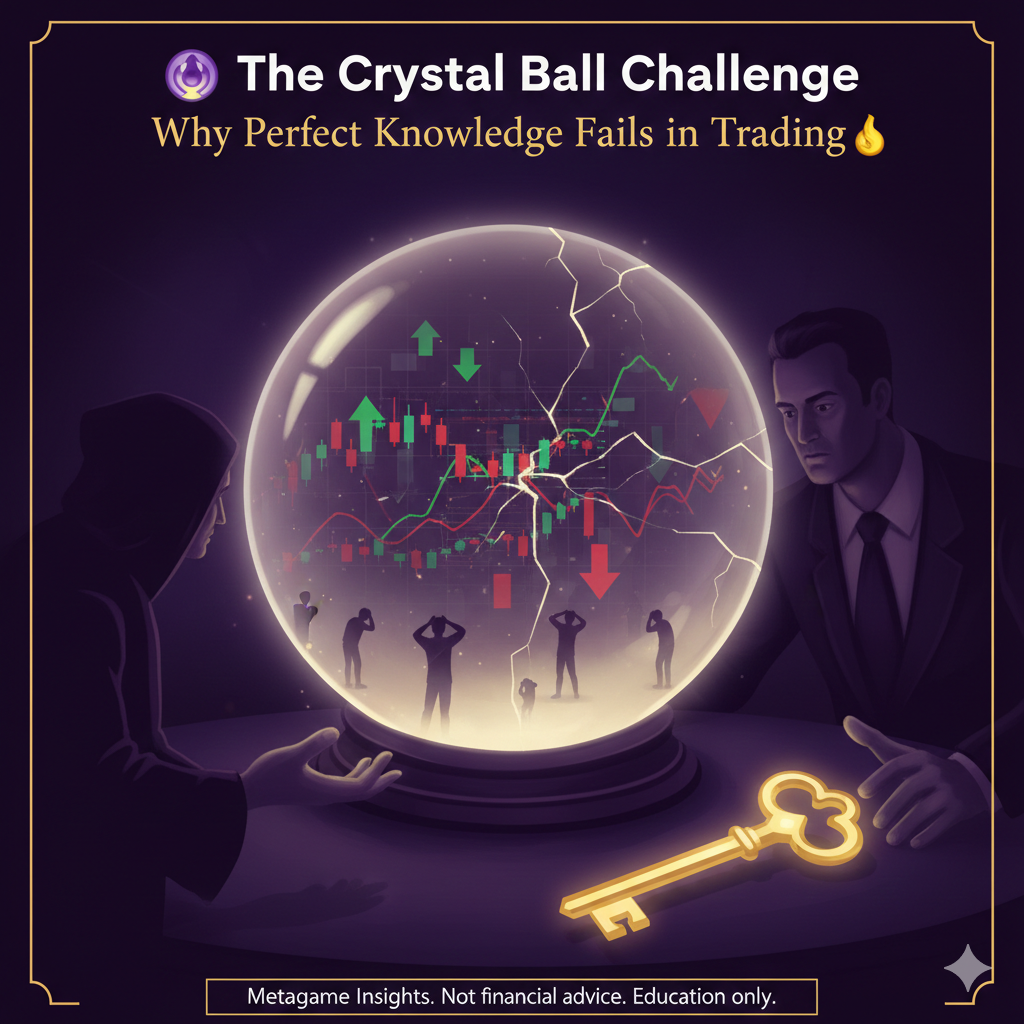
The Illusion of Certainty
Every trader, at some point, wishes for a crystal ball—a glimpse into tomorrow’s market headlines. The assumption is universal: Perfect information guarantees perfect profits. If you knew the outcome of today’s Fed meeting, the earning results of the top tech stock, or the precise unemployment figures 36 hours in advance, your success would be automatic and limitless.
But what if the opposite were true? What if even perfect foresight failed to translate into predictable wealth?
The Crystal Ball Challenge is a landmark experiment in behavioral finance that puts this fantasy to the ultimate test. It provides a brutal, factual demonstration that information is not the edge; execution is. For proprietary traders, where discipline, risk management, and execution skills are the only true currency, this experiment serves as the most critical lesson in humility and process mastery.
Phase I: The Experiment Setup and Shocking Results 🧪
Researchers, whose work inspired the concept of the “Crystal Ball Challenge,” set out to prove how professionals would perform with an unprecedented informational edge.
The Setup: Foresight on the Trading Floor
Financially savvy participants, including university finance students, MBA candidates, and even experienced professional traders, were given a starting amount of hypothetical capital (or a smaller stake in a real game). Their task was to trade the S&P 500 index and 30-year US Treasury bonds over a series of days.
The “crystal ball” advantage was the unprecedented foresight: Participants were shown the front page of the Wall Street Journal for the following day (36 hours in advance). They knew tomorrow’s major economic data, political announcements, and corporate earnings headlines before placing their trades today.
The Shocking Outcome: A Failure of Conversion
The results were a devastating indictment of the idea that information equals profit:
| Category | The Rational Hypothesis (Expected) | The Actual Result (Observed) |
| P&L Outcome | Participants should become universally and instantly rich, as they possess near-perfect foresight. | Roughly half of all participants lost money. One in six actually went bust (lost all their capital). The average return was a paltry 3.2% over the 15-day period. |
| Directional Accuracy | Participants should be correct almost every time. | They guessed the correct direction of the stock and bond markets only 51.5% of the time—barely better than a coin flip. |
| Professional Edge | Professional traders should show a massive, consistent edge over students. | While professional traders did perform better (median gain of 60%), they struggled with consistency and found the challenge much harder than expected. |
The overwhelming conclusion: The ability to convert information into profit is the true challenge, not the acquisition of the information itself.
Phase II: Why Perfect Knowledge Fails – The Two Execution Gaps 🧩
The experiment demonstrates that the failure was not in the data provided, but in the crucial stages that follow: Interpretation and Risk Management. These are the two execution gaps that swallow perfect foresight whole.
1. The Interpretation Challenge: News $\neq$ Direction
The biggest failure was not in knowing what the news would be, but in predicting how the market would react to it.
- Ambiguity and Context: A headline like “Federal Reserve Holds Rates Steady” might sound neutral. However, if the market consensus was aggressively pricing in an expected interest rate cut, the “neutral” news is received as a massive disappointment. The known headline leads to a large sell-off. The traders struggled to predict the Second-Order Effect—the market’s reaction relative to its pre-existing expectations, which the crystal ball did not reveal.
- The Problem of “Priced In”: The market is a vast, complex network where millions of participants are constantly trying to price in future events. By the time a news event is public (even if known 36 hours in advance), the market’s reaction is often fleeting, volatile, or counter-intuitive because the information was already discounted or poorly interpreted in the context of global sentiment. The simple fact is: news is only valuable insofar as it deviates from the consensus expectation.
2. The Sizing Challenge: The Kelly Criterion Failure
This was the most damaging failure and the primary reason one in six participants went bust. It is the ultimate testament to the importance of optimal position sizing.
- Excessive Leverage and Overconfidence: Knowing the headlines created a massive surge of overconfidence in the participants. They mistook foresight for guaranteed success. This led them to use catastrophic leverage (often over 20x capital) on trades they felt certain about.
- Ruin Risk: With such high leverage, if their interpretation was even slightly wrong, or if the market moved against them momentarily before ultimately aligning with the news, the high leverage led to immediate ruin (margin call). They lacked the discipline to match their conviction level to their risk-sizing model.
- Lack of Edge Quantification: The traders knew what would happen, but they did not know how much the market would move, or how volatile the path to that move would be. Without quantifying the magnitude of the edge, they couldn’t calculate an optimal position size (like the Kelly Criterion) to capitalize fully without risking their entire bankroll.
Phase III: The Behavioral Failure – Why Smart Traders Self-Sabotage 😡
The final layer of failure is purely psychological. The Crystal Ball Challenge exposed the core human bias that contaminates even the best information: Emotional Contamination.
3. Mistaking Conviction for Edge
Perfect information creates absolute conviction. But in trading, conviction is not a substitute for a quantified, tested edge that includes a probabilistic assessment of outcome and risk.
- Emotional Contamination: The knowledge led to high-stakes emotional trading. When the market moved against their “certain” prediction, the frustration, anger, and feeling of injustice were magnified, often leading to impulsive behavior, wider stops, or revenge trading—all classic signs of a breakdown in execution discipline. They believed the market was “wrong,” not their interpretation or their sizing.
4. The Loss Aversion Trap
Because the participants were so sure of the outcome, the pain of the resulting loss was magnified two-fold, triggering a severe Loss Aversion response.
- When a trade based on known news went wrong, traders were more likely to hold the losing position too long or double down (average down) to avoid admitting that their certain information had failed. This refusal to accept the temporary loss, combined with high leverage, pushed them into ruin. The psychological cost of being “wrong” when you knew the answer was simply too high to allow for rational risk control.
This experiment proves that trading is a skill set that sits on top of information. Without mastery of risk and emotion, information becomes a highly potent weapon for self-destruction.
Phase IV: The Prop Trader’s Plan – Building a System for Imperfect Information 🛠️
The lesson of the Crystal Ball Challenge for professional proprietary traders is clear: Since you will never have perfect information, your system must be robust enough to survive when you are only 51.5% correct.
5. De-Coupling Conviction from Size (The Risk Focus)
Your system must procedurally eliminate the ability to size up based on confidence alone.
- The 1% Rule as an Iron Law: The only determinant of your position size must be the distance to your stop-loss and your predefined risk-per-trade (e.g., 1% of capital). Whether you are 50% or 95% certain about a trade, the risk remains 1%. This prevents the catastrophic over-leveraging that ruined the crystal ball participants.
- Quantifying the Edge: Do not enter a trade until you have calculated a verifiable Risk-to-Reward Multiple (R-Multiple). If you risk $1 to make $3, you know the magnitude of your potential return is three times the risk. This quantifiable metric is far more valuable than a “hunch” or even an early headline.
6. Building an Interpretation Filter (The Pre-Mortem)
Your interpretation of news must be procedural, not reactive. Use the Pre-Mortem technique:
- Before the Trade: For any major known news event (like the Fed meeting), write down two scenarios before the event is released:
- If the news is exactly as expected (e.g., rates hold steady), what is the market’s likely reaction, and why?
- If the market reacts counter-intuitively (e.g., sells off on good news), what is the non-negotiable price point that invalidates your trade?
- The Goal: This forces you to acknowledge market ambiguity and pre-define your exit before the emotional high of the news release, helping you survive the inevitable gap between news and market reaction.
7. The Acceptance of Complexity (The Probabilistic Mindset)
A professional trader does not seek certainty; they manage probability.
- Focus on Process Consistency: The outcome of any single trade is random and susceptible to the complexity of the market. Your focus must be on executing your robust strategy flawlessly 100 times. If your strategy is only 60% accurate, accepting the 40 losses is the cost of doing business. The emotional damage of a loss is minimized when it is viewed as a statistical contribution to the expected 40% loss rate.
- Review, Don’t React: When a trade goes wrong (even with a perceived informational edge), the response must be a systematic post-session analysis, not an emotional recoup attempt. The review asks: “Did I follow the process?” not “Why was the market wrong?”
Trading is a Skill Set, Not an Information Game 📈
The Crystal Ball Challenge is the greatest lesson available in behavioral finance. It shatters the illusion that information is the key to trading wealth. The participants had perfect foresight and still failed because they lacked the execution discipline and risk management mastery necessary to convert that foresight into consistent profit.
For the professional prop trader, the takeaway is absolute: Your edge is your process. Success is not about possessing more data than the next person; it is about the skillful interpretation of complexity, the unwavering adherence to risk rules, and the mastery of position sizing. Focus on controlling the two variables you can control—your risk and your behavior—and you will thrive in the imperfect, uncertain world where real money is made.
Disclaimer: This content is provided for educational and informational purposes only. It does not constitute, and should not be relied upon as, personalized investment advice, a recommendation to buy or sell any security, or an offer to participate in any trading activity. Trading involves substantial risk, and past performance is not indicative of future results.