
In the financial markets, there is a single variable that separates the institutional trading desk from the retail trader sitting at home. It is not access to capital. It is not superior information. It is not faster execution speeds.
It is the ability to kill a losing trade without hesitation.
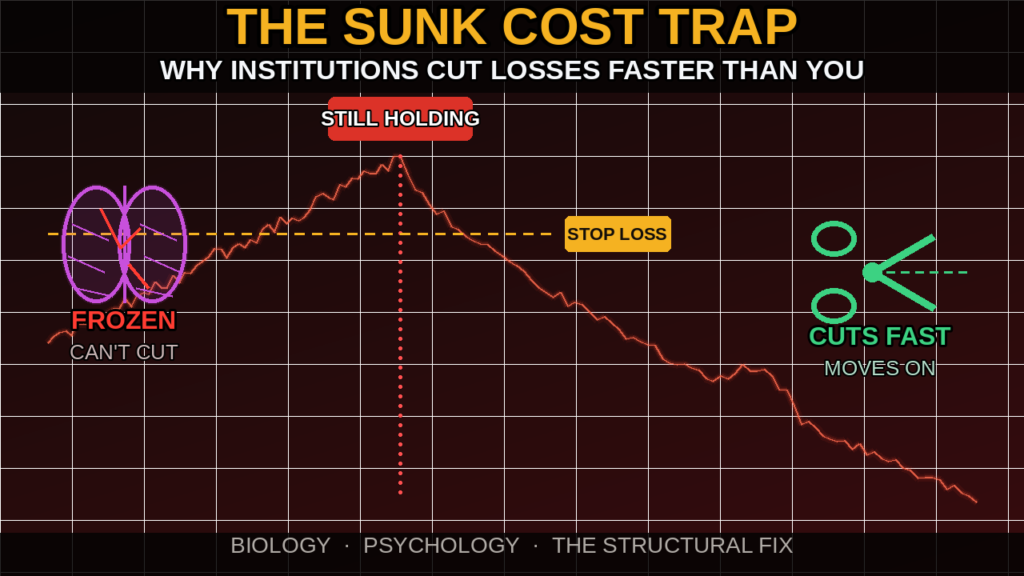
While the retail trader sits frozen, watching a position bleed through their stop-loss, the institutional desk has already moved on. The loss has been booked, the risk has been neutralized, and the capital has been redeployed into the next opportunity. This divergence is not a matter of skill or talent. It is a matter of structure versus psychology.
To understand why institutions cut losses faster than humans, you must first understand the Sunk Cost Fallacy—and why the human brain is biologically incapable of letting go.
🧠 What Is the Sunk Cost Fallacy?
The Sunk Cost Fallacy is a cognitive bias in which an individual continues a behavior or endeavor as a result of previously invested resources—time, money, or effort—even when the current evidence indicates that continuing is detrimental.
Let’s break that down into plain language.
Imagine you buy a movie ticket for $15. Twenty minutes into the film, you realize it is terrible. The plot makes no sense, the acting is awful, and you are genuinely bored. But you stay for the remaining two hours. Why? Because you “already paid for it.” You tell yourself that leaving would be “wasting” the money.
Here is the cold truth: the money is already gone. Whether you stay or leave, that $15 is spent. By staying, you are not getting your money back. You are simply adding two hours of misery to the loss. That is the Sunk Cost Fallacy in action.
In trading, it works exactly the same way. You enter a trade. It moves against you. The original setup that justified the entry is no longer valid. But you hold on. You tell yourself that if you just wait, the market will “come back” and you can “get out at breakeven.”
The market does not care what you have already spent. The market does not care what your entry price was. The market does not care how much time you spent on the analysis. Every second you hold a losing trade that has invalidated its original thesis, you are making a brand new decision to be in that trade.
The only question that matters is: Would I enter this trade right now, at this price, with this setup? If the answer is no, you should not be in it.
🏢 How Institutions Eliminate the Sunk Cost Trap
Professional trading firms do not rely on “discipline” or “willpower” to cut losses. They rely on automated kill-switches that remove the human from the decision entirely.
Here is a breakdown of the institutional risk management structure:
1. The Hard Daily Loss Limit 🛑
Every institutional trading desk operates with a Daily Loss Limit—a maximum amount of money a trader is allowed to lose in a single day. This is not a suggestion. It is not a guideline. It is a hard-coded parameter in the firm’s risk management software.
If a trader hits the limit, their positions are automatically liquidated (closed out), and their access to the trading platform is revoked for the remainder of the session. The trader does not get to argue. The trader does not get to explain why “this time is different.” The system enforces the limit without negotiation.
Why this matters for you: Many prop firms and modern trading platforms allow you to set your own Daily Loss Limit. This is not a “training wheels” feature. This is the exact same mechanism that professional desks use to protect themselves from human error.
2. The Position-Level Stop-Loss 🎯
A Stop-Loss is an order you place with your broker that automatically closes your trade if the price moves against you by a specified amount. At the institutional level, every single position has a pre-defined stop-loss that is entered into the system at the moment of execution.
This stop-loss is not a mental note. It is not a “line in the sand” that can be redrawn when the market gets close. It is an electronic order resting on the exchange. If the market hits that level, the position is closed. No hesitation. No second-guessing. No “let me just see what happens in the next five minutes.”
3. The Risk Desk 👁️
Larger institutions employ a dedicated Risk Desk—a team whose sole function is to monitor exposure and enforce limits. This team operates independently of the trading desk. They have no emotional attachment to any individual trade. They do not care about the story behind the position. They see numbers on a screen, and if those numbers exceed pre-defined thresholds, they close the trade.
This is the ultimate separation of ego from execution. The person making the decision to cut the loss is not the same person who entered the trade. There is no pride to protect. There is no need to “be right.” There is only the cold, mathematical reality of risk exposure.
Key Insight: The institutional model works because it removes the biological organism from the decision loop.
🧬 Why the Human Brain Cannot Do This Naturally
The human brain, by contrast, is wired to do the exact opposite of what the institution does. Here is why:
The Ego Problem 🪞
When a retail trader enters a position, that position becomes an extension of their identity. If the trade is a winner, they are smart. If the trade is a loser, they are stupid. This is an absurd framework—one losing trade says nothing about your intelligence—but it is how the brain operates.
Closing a losing trade is not just a financial event. It is an admission of error. It is a blow to the ego. The brain would rather hold the position and hope for a reversal than confront the psychological pain of being “wrong.”
The institution does not have an ego. The algorithm does not have an ego. The risk desk does not have an ego. They have parameters, and they execute them.
The Dopamine Trap 🧪
Dopamine is a neurotransmitter—a chemical messenger in the brain—associated with reward, pleasure, and anticipation. When a trade moves against you, the brain experiences a dopamine deficit. It craves a “fix”—a return to breakeven, a recovery of the loss.
This craving is chemically identical to what a gambler experiences at a slot machine. The brain is not analyzing the market. It is seeking relief from the pain of the loss. Every tick in your direction provides a small hit of hope. Every tick against you deepens the desperation.
The institution is immune to this because the institution does not have a dopamine system. It has rules.
Confirmation Bias 🔍
Confirmation Bias is the tendency to search for, interpret, and remember information in a way that confirms your pre-existing beliefs. When you are in a losing trade, your brain will actively seek out reasons why you are “right” and ignore all evidence that you are wrong.
You will find the one analyst who agrees with your direction. You will focus on the one timeframe that still looks bullish. You will dismiss the opposing data as “noise.” This is not analysis. This is your brain protecting its ego at the expense of your account.
📉 The Retail Trader’s Self-Destruction Sequence
When a retail trader falls into the Sunk Cost Trap, a predictable sequence of events unfolds. This is not a hypothetical scenario. This is the documented, repeatable pattern that destroys trading accounts:
Step 1: The Denial Phase 🫣 The trade moves against the entry. The trader tells themselves it is “just a retracement” or a “liquidity grab.” They ignore the technical invalidation because acknowledging it would mean admitting the trade was wrong.
Step 2: The Widening Stop ↔️ The original stop-loss level is approached. Instead of accepting the loss, the trader widens the stop—moving it further away from the entry price. They tell themselves the market is “irrational” and that they just need to give the trade “more room to breathe.”
Step 3: The Hopium Phase 💨 The trade continues to move against them. The trader is now significantly underwater—meaning their unrealized loss is far larger than their original risk. They begin searching desperately for any scrap of information that supports their original thesis. Confirmation Bias is now running at full power.
Step 4: The Capitulation 📉 The pain becomes unbearable. The trader finally closes the trade—not because it makes strategic sense, but because they can no longer tolerate the emotional distress. The loss is now two, three, or five times larger than the original stop-loss would have been.
Step 5: The Revenge Trade 🔥 The trader, now in a state of chemical desperation, immediately enters a new position to “make it back.” This trade is entered without analysis, without a stop-loss, and often with increased position size to “accelerate” the recovery. This is the moment most prop trading accounts are completely blown.
Every step of this sequence is driven by biology, not logic.
🛠️ The Structural Solution: Becoming Your Own Risk Desk
If you are a retail trader or an aspiring prop trader, you cannot hire a dedicated risk desk. But you can replicate the institutional structure by implementing automated circuit breakers—pre-set rules that function as your own personal kill-switch.
1. Platform-Enforced Daily Loss Limits ⛔
Most modern trading platforms and prop firm interfaces allow you to set a Daily Loss Limit that locks you out of the platform when triggered. This is the single most important risk management feature available to any trader.
Set it. Do not negotiate with it. Do not disable it when you are “confident.” The limit exists precisely for the moments when your confidence is highest and your judgment is most impaired. If you find yourself thinking about disabling the limit, recognize that thought as the first symptom of the very problem the limit was designed to prevent.
2. Hard Stop-Losses at Entry 🔒
Enter your stop-loss as an electronic order at the moment of execution. Once it is set, it cannot be moved. If you find yourself wanting to widen a stop, recognize that impulse for what it is: the Sunk Cost Fallacy activating your ego’s defense mechanisms.
A hard stop-loss means the decision to exit has already been made. You made it before the trade was live, when your brain was calm and your analysis was clear. Honor the decision you made when you were rational, not the impulse you feel when you are under threat.
3. The Post-Loss Lockout Rule ⏳
Institutional traders are often required to step away from the desk after a significant loss. Implement the same rule for yourself. After a stop-loss is hit, you are locked out for a minimum period—15 minutes, 30 minutes, or the rest of the session.
This forced cooldown allows your cortisol levels—the stress hormone that floods your system during a loss—to normalize. It allows your prefrontal cortex—the part of your brain responsible for logic and decision-making—to come back online. You cannot trade your way out of a chemical hijack. You can only wait it out.
4. R-Multiple Thinking 📐
An R-Multiple is a way of measuring your trades in units of risk rather than dollars. If you risk $100 on a trade, that $100 is your “1R.” A win of $200 is a “+2R” trade. A loss of $100 is a “-1R” trade.
When you think in R-multiples rather than dollar amounts, you detach the trade from its emotional weight. A “-1R” loss is not “I lost $500.” It is “I executed my plan and the trade did not work.” This shift in framing is critical for keeping your analytical brain in control.
📊 A Quick Reference: Institution vs. Retail Trader
| Factor | Institution | Retail Trader |
|---|---|---|
| Stop-Loss | Hard-coded electronic order at entry | Mental note, often ignored or widened |
| Daily Loss Limit | Automated platform lockout | “I’ll stop after one more trade” |
| Risk Oversight | Independent Risk Desk | None—self-monitored |
| Decision-Maker | Algorithm or separate team | Same person who entered the trade |
| Post-Loss Protocol | Mandatory cooldown period | Immediate revenge trade |
| Measurement | Risk units and statistical expectancy | Dollar signs and P&L |
🏁 The Cold Reality
The market does not reward loyalty. It does not care about your entry price. It does not respect your effort. The market is an amoral, indifferent system that will take everything you have if you refuse to manage your risk.
Institutions understand this. That is why they have built systems that eliminate the human from the risk management process. They do not trust themselves, so they build structures that cannot be overridden by emotion.
The retail trader who refuses to adopt these same structures is not “fighting the market.” They are fighting their own biology. And biology, left unchecked, will always choose the path of least psychological pain—even when that path leads directly to a blown account.
Cut the loss. Move on. The next trade does not care about the last one.
Disclaimer: This information is for educational and informational purposes only and does not constitute financial, investment, or legal advice. Trading in financial markets involves significant risk of loss and is not suitable for all investors. Any decisions made based on this content are the sole responsibility of the reader.